CHAPTER 03 / 06
Chapter 3: A fence, a carrot, and a reusable recipe
The Worm Farm has a house and a rake. Now it needs a garden. The farmer requests one carrot and a fence to protect it from the tractor we will build next. Planning is improving.
Repeating a whole expression worked for rake teeth. A fence post adds a pointed cap and may need several dimensions. Give that recipe a name with define-component.
Package one proven post
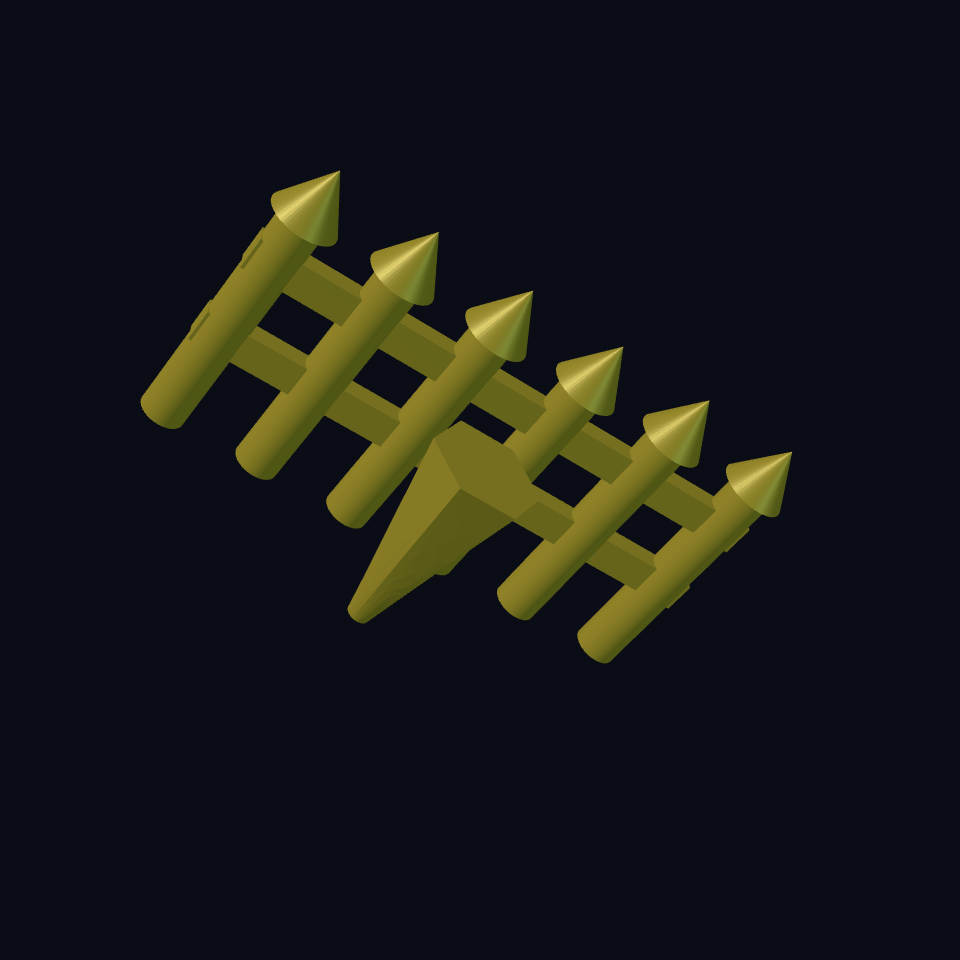
A component declaration goes before model; its signature lists inputs and defaults. Our fence_post accepts x and height. It builds a cylinder plus a cone, then moves the result to X = x. Calling (fence_post :x 18mm) uses the default height; calling it with :height 30mm overrides that height too.
The colon marks a named input. The name x belongs to this component's signature; it is a scalar position, not an implicit coordinate vector.
A component's geometry sees its signature, local bindings, and allowed immutable top-level helpers. It cannot reach arbitrarily into a model's controls. Pass a needed value in the signature. This keeps the recipe usable somewhere else.
Grow a fence from that recipe
posts sets a count, and the repeat calls the component at i × 9mm. Six posts land at 0, 9, 18, 27, 36, 45. Two box rails cross them at Z = 8 and 16. Here the rails' length is derived from the count, so a longer row gets longer rails too.
The rail length is (posts - 1) × 9mm + 4mm. The centre is half the distance from first to last post. That gives a 49 mm rail centred at X = 22.5 for six posts. The extra 4 mm covers the post radii at both ends.
Grow a ridiculous carrot
The carrot's bottom profile is a small circle of radius 1. Its top is an explicit six-sided polygon of radius 5. loft 18mm joins those profiles 18 mm apart. This is a deliberately stylised carrot, not a cylinder with an ignored facet count.
A loft joins two outlines at different heights. Changing the top profile changes the carrot's shape without changing its height.
Build the garden
(define-component fence_post ((number x 0mm) (number height 22mm))
  (translate x 0 0
    (union
      (cylinder 2mm height)
      (translate 0 0 height
        (cone 3mm 0mm 5mm)))))

(model
  (params
    (number posts 6 :label "Fence posts" :min 3 :max 9 :step 1))

  (part fence
    (let* ((post_row
             (repeat-union i posts
               (fence_post :x (* i 9mm))))
           (rail_length (+ (* (- posts 1) 9mm) 4mm))
           (rail_center (/ (* (- posts 1) 9mm) 2))
           (bottom_rail
             (translate rail_center 0 8mm
               (box rail_length 2mm 3mm)))
           (top_rail
             (translate rail_center 0 16mm
               (box rail_length 2mm 3mm))))
      (union post_row bottom_rail top_rail)))

  (part carrot
    (translate 20mm -12mm 0
      (loft 18mm
        (circle 1mm)
(regular-polygon 6 5mm)))))Reuse without hiding dependencies
- Increase
postsfrom 6 to 8. Predict rail length:7 × 9 + 4 = 67mm. Render and count. - Add
:height 28mmto the component call. All posts grow; their caps remain 5 mm tall. The rails stay at their original heights. - Change the component body to use an undeclared
magic_height. Compilation should reject the free variable. Restoreheight. - Keep the component definition and copy it into a new model. It should work with its declared inputs alone.
You can now: declare reusable geometry, pass named inputs, derive a repeated support's size, and loft a profile into a changing solid. Next chapter uses reusable recipes for wheels, axles, and retaining rivets.